Slop Oil & Waste Fuel Recycling
Separation systems that break stable oil, water and solids emulsions and send the recovered oil to re-refining or back to crude processing.
- Heating & demulsifier dosing
- Three-phase centrifugal separation
- Dehydration & flash evaporation
- Light-ends recovery
- Routing to re-refining or crude
- Skid-mounted packages
Every proposal starts from your feed data. Figures on this page are typical process data; final plant performance is confirmed during design.
Oil worth recovering, locked in an emulsion
Wherever oil is produced, stored, transported or refined, some of it ends up mixed with water and dirt. Tank bottoms, interceptor skimmings, line flushings and recovered spills all produce the same kind of material: an off-spec mixture that no buyer will accept as it is, yet still contains a large share of usable hydrocarbon.
Left untreated, these residues occupy tank space, carry disposal charges and pose an environmental risk. Treated properly, the oil can return to a refinery or re-refinery as feedstock, the water can go to effluent treatment and the solids can be handled as a much smaller waste stream.
Fine droplets of water are held inside the oil by natural surface-active compounds and fine particles that coat each droplet. These films stop droplets from merging, so gravity alone works slowly and leaves a stubborn middle layer.
Schematic only. Proportions vary widely from one source to another; a lab bottle test on each feed guides heating and chemical dosing.
| Technique | How it works | Where it fits |
|---|---|---|
| Heating | Warmer oil is thinner, so droplets move and merge more easily | Always applied ahead of separation |
| Emulsion breakers | Chemicals displace the stabilising film on droplets so they can coalesce | Dosed upstream; selected by bottle test |
| Gravity settling | Time in a tank lets free water and heavy solids drop out | Bulk pre-separation and buffering |
| Three-phase decanter centrifuge | Rotating bowl multiplies gravity and splits oil, water and solids in one pass | Main separation step in HiTorq units |
| Disc-stack polishing | High-speed separator removes the last fine water and particles | Optional, when a drier oil is needed |
Split the phases, then recover the cuts
HiTorq treatment trains are configured around the feed: its water and solids content, how stable the emulsion is, and where the recovered oil will go next. The aim is a clean oil that can be blended into a refinery feed or sent on to a used-oil re-refining plant.
- Reception & screeningCoarse debris removed; feed homogenised in a heated tank.
- ConditioningFeed warmed and dosed with emulsion breaker.
- Decanter centrifugeContinuous split into oil, water and a solids cake.
- DehydrationRemaining moisture flashed off under heat.
- Light-end recoveryLighter hydrocarbons evaporated and condensed as fuel cuts.
- Heavy oil to further processingHeavier fraction sent to vacuum distillation and finishing.
To the effluent plant
Reduced volume for disposal
Reused as fuel or blendstock
Refinery feed or re-refining
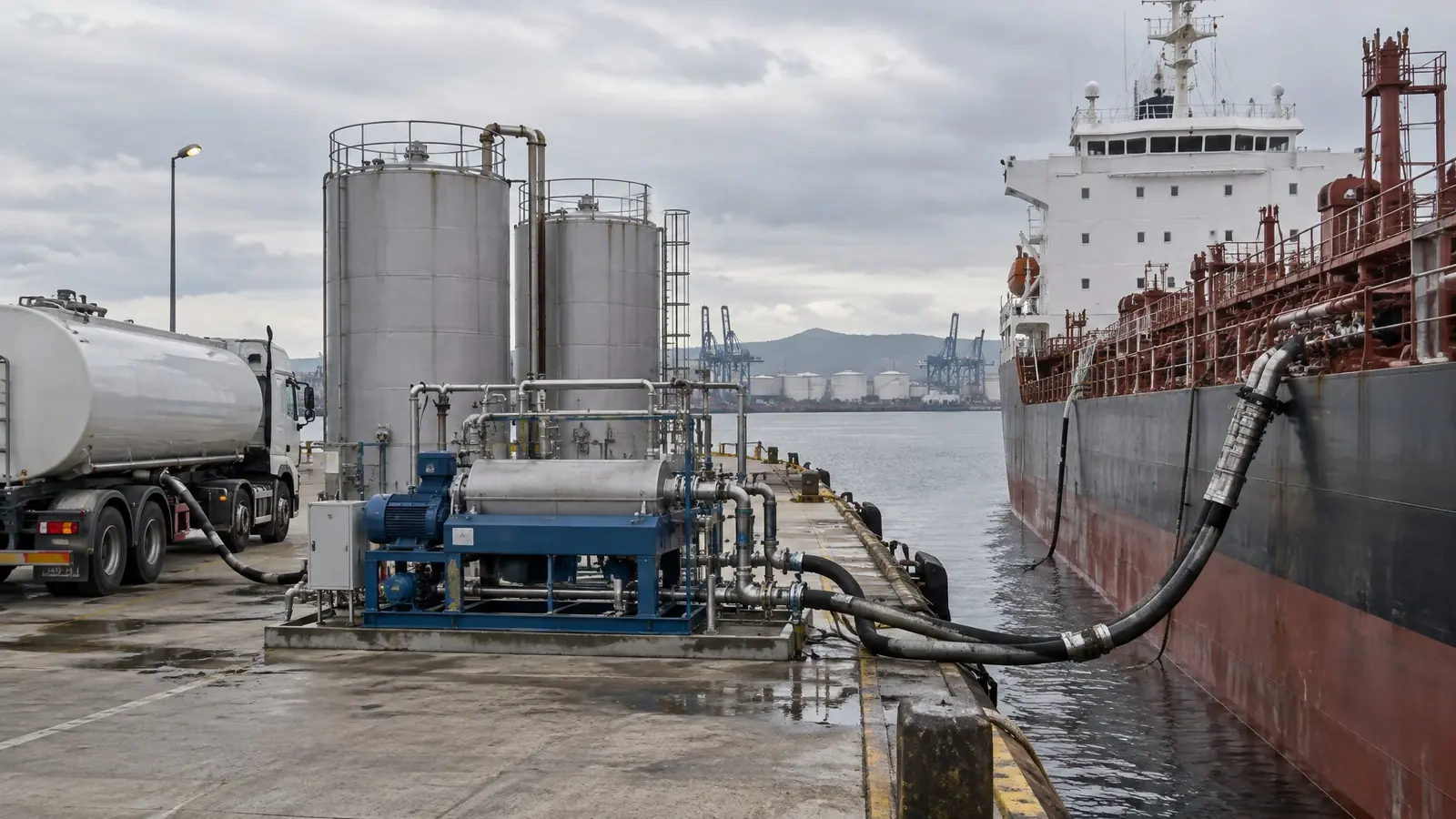
Vessels produce sludge from fuel and lube oil purifiers and oily bilge water. Under MARPOL Annex I these must be discharged ashore to port reception facilities. Terminals, depots and tank-cleaning operators handle comparable waste fuel oils. All of these can be processed on the same kind of separation and recovery train, so material that would otherwise be a disposal burden is turned back into oil.
Mobile skids for tank cleaning, or permanent units at terminals and refineries.
Temperature, dosing and centrifuge settings managed from a PLC panel.
Capacities engineered to client requirement and feed analysis.
Have a feed to evaluate for slop oil / marpol?
Send us your feed details, target products and capacity. We will reply with a technical route and the scope of supply.