
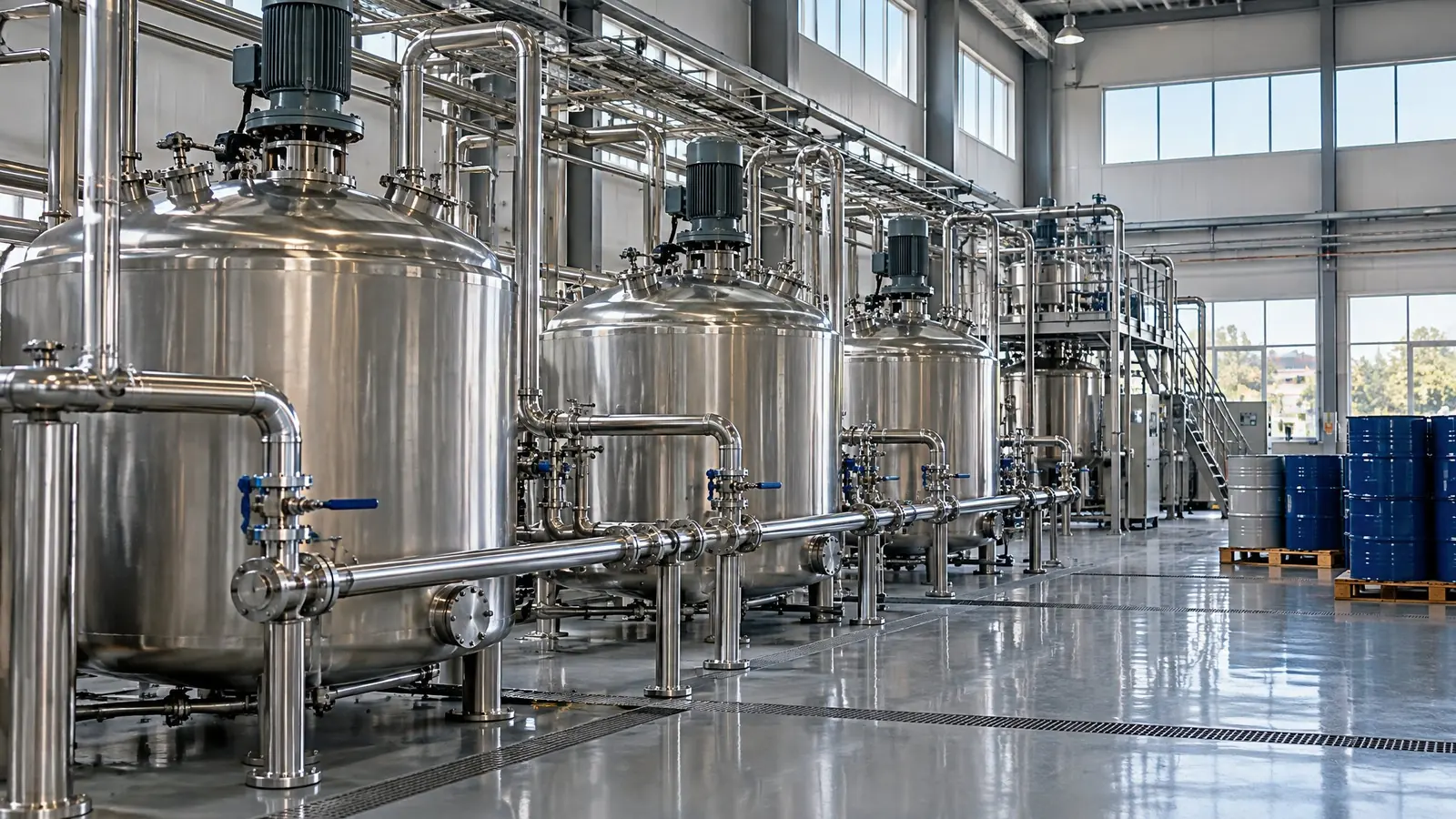
Lube Oil Blending Plant
Blending plants that combine base oils and additives to a formula, with storage, mixing, quality control and filling planned as a single process line.
- Base oil & additive tank farm
- Batch & in-line blending
- Additive dosing & heating
- QC laboratory interface
- Small-pack to drum filling
- Packaging & palletising
Every proposal starts from your feed data. Figures on this page are typical process data; final plant performance is confirmed during design.
A recipe, repeated exactly
A finished lubricant is mostly base oil. The rest is an additive package that gives the oil its working character: keeping engines clean, protecting gears under load, resisting oxidation, flowing in the cold. The share of additives varies widely, from very little in some industrial oils to a substantial portion of heavy-duty engine oils.
The blending plant’s job is simple to state and demanding to deliver: combine the right base oils and additives in the right proportions, at the right temperature, without contamination, and prove it with a lab result before the product is packed.
| Additive type | Function in the finished oil |
|---|---|
| Detergents & dispersants | Keep soot and deposits suspended so surfaces stay clean |
| Anti-wear & extreme pressure | Form protective films on metal under heavy load |
| Antioxidants | Slow oil breakdown at high temperature and extend drain intervals |
| Viscosity modifiers | Reduce thinning with heat, enabling multigrade oils |
| Pour point depressants | Help the oil flow at low temperatures |
| Corrosion & rust inhibitors | Protect metal surfaces from moisture and acids |
| Anti-foam & demulsifiers | Release entrained air and separate water |
| Group | General description |
|---|---|
| I | Conventional solvent-refined mineral oils |
| II | Hydrotreated mineral oils with low sulphur |
| III | Hydrocracked mineral oils with high viscosity index |
| IV | Synthetic polyalphaolefins (PAO) |
| V | Other base stocks, e.g. esters and naphthenic oils |
Accurate blends, clean packs
Base oils received, stored and heated
Drum decanting, heating and day tanks
Load cells or flow meters, recipe control
Heated kettles with agitation
Lab approval of every batch
Filtration, filling and packing
| Method | Best for | Note |
|---|---|---|
| Batch kettle blending | Wide grade range, smaller batches, simple operation | Lowest entry cost |
| Simultaneous metering | Faster batches with components dosed together | Shorter cycle times |
| Automated in-line blending | High-volume grades blended straight to tank or filler | Highest throughput |
The method is chosen from your grade list, batch sizes and growth plan. Many plants start with batch kettles and add automated metering later. Capacities are engineered to client requirement.
- Base oil and additive storage with heating
- Drum handling and decanting
- Blending kettles, mixers and transfer pumps
- Line flushing and pigging to limit cross-contamination
- Finished product tanks
- Bottle filling for retail packs
- Pail and bucket filling
- Barrel and drum filling
- Capping, induction sealing, labelling
- Batch coding and cartoning
- Recipe management and batch records
- PLC / HMI control of dosing and transfers
- Lab for viscosity, flash point, pour point and more
- Sampling points at every stage
- Safe handling of additive concentrates
- Own formulations and private-label brands
- Consistent quality, batch records for every lot
- Base oil bought in bulk, packed close to market
- Flexible grade and pack changes
Have a feed to evaluate for lube oil blending plant?
Send us your feed details, target products and capacity. We will reply with a technical route and the scope of supply.