
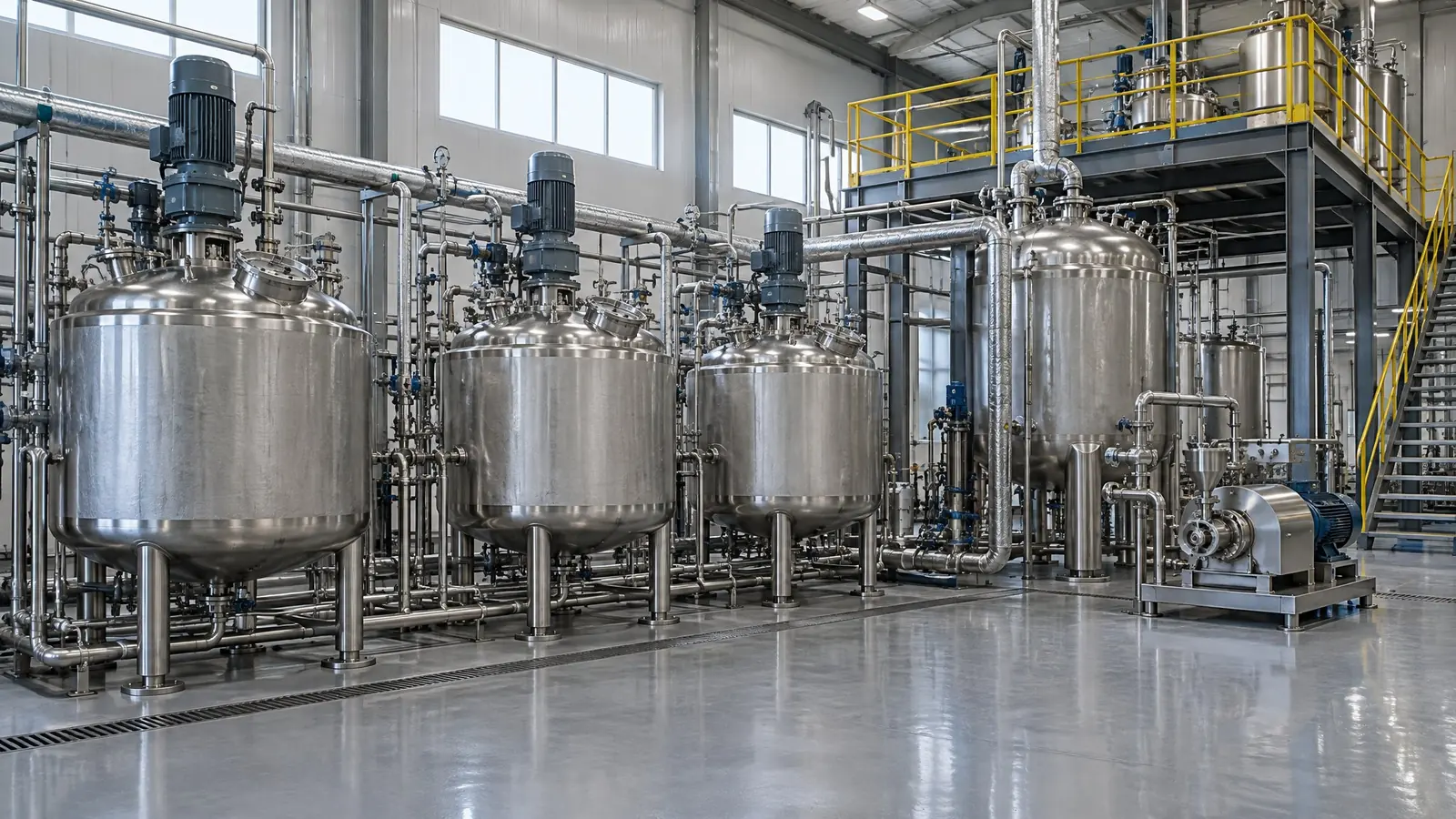
Grease Manufacturing Plant
Batch grease plants from reaction to filled pack: kettles or contactors, finishing, milling, de-aeration and filling, laid out as one integrated line.
- Pressurised contactor / open kettle
- Finishing & cooling kettles
- Homogeniser / colloid mill
- De-aerator & filtration
- Cartridge, tin & drum filling
- Utilities & thermic fluid system
Every proposal starts from your feed data. Figures on this page are typical process data; final plant performance is confirmed during design.
Oil, held in place by a thickener
Grease is a lubricating oil locked inside a thickener structure, usually a metallic soap formed in the plant itself. The base oil does the lubricating. The thickener holds it where it is needed and releases it under load. Additives then adjust the grease for pressure, water, rust or temperature.
Product quality comes from controlling the reaction, the heating and cooling curve and the shear given to the finished grease. A HiTorq grease plant is laid out around those three controls, from raw-material charging to the filled pack.
- ChargingBase oil, fatty acid and alkali are metered into the reactor.
- SaponificationSoap is formed in a pressurised contactor or an open kettle, heated by thermic fluid.
- DehydrationReaction water is driven off to build the thickener structure.
- Finishing & coolingCut-back with base oil, controlled cooling and dosing of additives.
- Milling & de-aerationHomogeniser or colloid mill sets texture; vacuum de-aerator removes entrained air.
- Filtration & fillingStrained grease goes to cartridge, tin, bucket or drum filling.
| Section | Main equipment | What it controls |
|---|---|---|
| Raw material handling | Base oil tanks, fatty acid melting, alkali preparation, transfer pumps | Correct charge and temperature at the start of each batch |
| Reaction | Pressurised contactor or open soap kettle with scraper agitator | Speed and completeness of the soap reaction |
| Finishing | Finishing / cooling kettles with counter-rotating agitators | Thickener structure, consistency and additive dispersion |
| Shear & de-aeration | Homogeniser or colloid mill, vacuum de-aerator | Smooth texture, stable consistency, no air pockets |
| Filtration | Inline grease filters / strainers | Removal of hard particles and lumps |
| Filling & packing | Cartridge, tin, bucket and drum fillers; capping and labelling | Accurate fill weight and clean, sealed packs |
| Utilities | Thermic fluid heater, cooling water, compressed air, vacuum system | Stable heating and cooling curves batch after batch |
Closed reactor with high internal circulation. Shorter reaction time and good heat transfer; suited to plants that make soap greases in volume.
Jacketed kettle at atmospheric pressure. Simple to run and flexible for a wide product mix and smaller batches.
Kettle volume, number of finishing vessels and filling speed are sized to your product list and target output.
One plant, many greases
The same reaction and finishing train can make several grease families. The thickener you choose decides the reaction chemistry, the temperature profile and the equipment duty, so we size the plant around your product list rather than a single grade.
| Thickener family | Typical use | Plant note |
|---|---|---|
| Lithium soap | Multipurpose automotive and industrial greases | Contactor or kettle route |
| Lithium complex | Higher-temperature wheel-bearing and industrial duty | Extra complexing step |
| Calcium soap | Water-resistant general-purpose greases | Lower process temperature |
| Calcium sulphonate | Heavy-duty, wet and corrosive service | Longer conversion cycle |
| Aluminium complex | Food-processing and water-exposed equipment | Kettle route |
| Clay (bentonite) | High-temperature, non-melting greases | No reaction; dispersion and milling |
- Cartridge filling for grease-gun packs, with capping.
- Tin and bucket filling by weight, with lid pressing.
- Drum and barrel filling for bulk customers.
- Labelling, coding and cartoning to close the line.
- Semi-automatic or automatic lines, chosen to suit output and pack mix.
- Cone penetration to confirm consistency (NLGI grade).
- Dropping point for the temperature limit of the thickener.
- Water washout and corrosion checks for wet service.
- Mechanical stability after working.
- Lab layout and test equipment list supplied with the plant.
- Grease families and grades
- Target output per shift
- Batch size per grade
- Pack types and mix
- Available utilities
- Building and site layout
Have a feed to evaluate for grease plant?
Send us your feed details, target products and capacity. We will reply with a technical route and the scope of supply.