
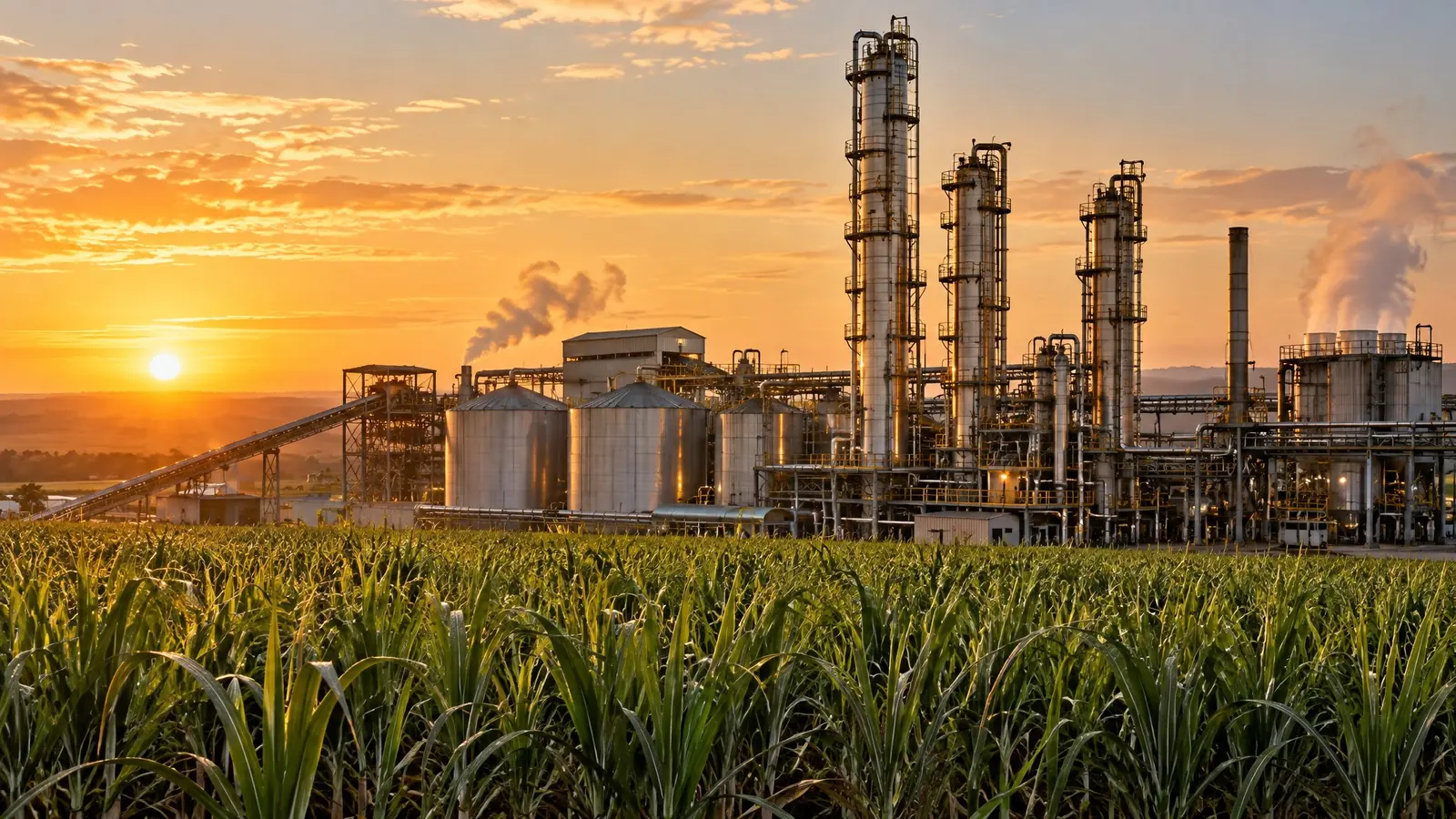
Ethanol Manufacturing Plant
Turnkey ethanol plants for sugar-based feedstocks, from fermentation to fuel-grade dehydration, engineered for low steam use and minimal waste water.
- Feedstock preparation
- Fermentation
- Multi-column distillation
- Dehydration to fuel grade
- Potable alcohol option
- Evaporation & effluent treatment
Every proposal starts from your feed data. Figures on this page are typical process data; final plant performance is confirmed during design.
Complete ethanol distilleries
Ethanol is made by letting yeast convert sugar into alcohol, then separating that alcohol from water. The chemistry is old; the economics depend on doing it with as little steam, power and water as possible. HiTorq engineers distilleries as one integrated system, from feed handling through fermentation, distillation and dehydration to the treatment of spent wash.
Sugar-rich crops and the by-products of sugar mills are the natural feedstocks. For a sugar producer, a distillery turns surplus juice or molasses into a product with a large and growing market in fuel blending, alongside industrial and potable alcohol.
Fermented directly after clarification, or stored as concentrated syrup.
The residual sugar from crystallisation, diluted before fermentation.
Juice from crops such as sweet sorghum or sugar beet, where available.
Dilution, clarification, sterilisation
Yeast turns sugar into a dilute “wash”
Alcohol stripped and concentrated
Last water removed for fuel grade
Concentrated and treated
Ethanol and water form an azeotrope at roughly 95 % ethanol: beyond that point the vapour has the same composition as the liquid, so further distillation achieves nothing. Fuel blending needs almost water-free alcohol, so the final water is taken out by other means, most commonly molecular-sieve adsorption.
Efficiency decides the economics
Most of a distillery’s running cost is energy, and most of that energy goes into boiling liquid in the distillation columns and evaporators. Good design reuses that heat several times: columns operated at different pressures so one condenses into the next’s reboiler, vapour recompression where power is cheap, and hot product streams preheating the feed.
The second priority is water. Spent wash from the columns is the largest liquid stream on site. Concentrating it in multiple-effect evaporators recovers clean condensate for reuse and leaves a smaller, thicker stream that can be burnt in a boiler or composted, depending on local practice and regulation.
| Section | What it does | Design priority |
|---|---|---|
| Feed handling | Receives, dilutes and conditions juice, syrup or molasses | Hygiene, steady feed quality |
| Fermentation | Yeast propagation and fermenters, batch or continuous | Yield, temperature control |
| Distillation | Strips alcohol from the wash and concentrates it | Heat integration, steam per litre |
| Dehydration | Molecular-sieve units produce fuel-grade ethanol | Product dryness, regeneration energy |
| Rectification | Extra columns remove impurities for neutral spirit | Purity, removal of fusel oils |
| Evaporation & effluent | Concentrates spent wash, recovers condensate | Water reuse, compliance |
| Utilities & storage | Cooling water, steam, CO₂ handling, product tanks | Reliability, safety |
Capacities and configurations are engineered to client requirement and feedstock availability.
Columns, reboilers and heat recovery designed as one system.
Evaporation and recycling planned into the flow sheet from day one.
Engineering, equipment, erection and commissioning handled by one team.
Have a feed to evaluate for ethanol plant?
Send us your feed details, target products and capacity. We will reply with a technical route and the scope of supply.